5th March 2012

First night there, weary from the flight and mentally exhausted from taking in Angkor Wat's magnificence, I remembered returning from the temples and taking a dip in the hotel's swimming pool while Karling collapsed in bed. We didn't do much that night except our hunger brought us somewhere nearby for yummy Cambodian dishes with rice.
So this blog review started from our 2nd night at Siem Reap. Here is my city's night life review..

The staple food in Cambodia, like all over Asia, is rice, a rich source of carbohydrate. Most of the local restaurant in Siem Reap served rice with local cuisine which consist of meat in aromatic spices, in addition to stir fried vegetables and varieties of clear soup. We walked from our hotel towards the night market district, surveying the rows of eateries along the way.
For a local authentic experience, we patronized the eateries which had local Cambodian eating in it. As we sat down, immediately we were shown a different menu which flashes price of food in USD. So much for the experience, I supposed we had to pay tourist price to dine with the locals. We took it in good stride,however, to support the country's tourism industry. As we were famished, the food tasted so good it almost felt like non-spicy Thai food.

After a hearty dinner, we walked towards the night market at the heart of the business district. Along the way there were several other satellites fleece markets, selling a variety of souvenirs, painting, T-shirts and crafts. The fleece market was neat and organized, where the vendors were polite and not obtrusive. The bright lights illuminated the market and its sale items, which made shopping a breezy and enjoyable experience.


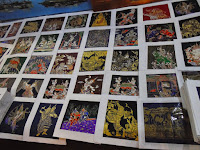
It is apparent that the bulk of Siem Reap locals derived their rice bowl from art crafts ie paintings, wood crafts, stone carvings, etc. Nearly every corner of the night markets offers sales of paintings, with majority of them depicting Angkor Wat, Bayon temples, landscape of villages, and simple life of the Angkor monks' pilgrimage. Since these paintings are numerous, naturally many are copied version of the original. Credits should still be given to the young talents who candidly repainted or reproduce fail proof original ideas.
Besides oil paintings, there were patterns directly copied from the bas-relief walls of Angkor Wat, showing great celestial war or Angkorian army procession taking place. Being an art admirer, albeit couldn't afford art collection, it crossed my mind multiple times to purchase at least a painting which could decorate my home wall. I finally resisted the urge in order to keep within our limited travel budget.


Along the happening night markets of Siem Reap were the equally busy massage parlors that operated both outdoor and indoor. Masseurs can be seen hard at work giving the majority Western customers a rejuvenating foot, head and shoulder massage. After an exhausting hike around the temple kingdom, these tourist would naturally indulge in a blissful pampering massage that relaxed the mind and promote blood circulation at the same time.
A variant of foot massage came in the form of fish therapy, where one happily dipped his feet into a pool of piranha's domesticated cousins which happily nibble off some epidermis of the feet. We hired a full body massage session each, and were given 2 young chap to ply their trade on us, which wasn't all that remarkable.


I haven't been a well traveled person but I believe Siem Reap has a wide array of crafts and souvenirs for sale, all stem from the creatively skillful hands of the locals. Art is a living for them, which can be seen from paintings, wood and stone crafts, fashion accessories, jeweleries, clothing and bags. The market was bright and colorful, only thing missing were the buzzing tourist we encountered throughout the day. Business was a little slow that night, hardly any sight of patrons let alone bargaining.


We came across some shops selling local T-shirts with Angkor Wat theme. After choosing the shop which we reckoned had the most choices in terms of size, color and pattern, we dug for T-shirts as souvenirs and gifts, for both mine and Karling's family. Selling at USD 5-7, these simple attire were made of durable garments that were meant to last. I had a fun and fulfilling time shopping for these economical fail-proof gifts that will soon find their blessed delighted owners.


Instead of coming across shops that were exact replicas of each others ie selling the same stuffs, I was feasting my eyes, yes I could only window shop, on the wide array of sales display from each shop. Colorful handbags and backpacks which looked like multiple square shaped fabrics being sewn together caught my eyes. The same outstandingly creative design applied to skirts, which i had some doubt on its fashion savviness.
If these things doesn't stir your interest, how about cobra wine, a locally mixed cocktail derived from cobra, trusted by locals for its male vigor and vitality boosting effects.
6th March 2012


One of the optional activity that can be missed is the "Smile Of Angkor", a musical performance themed around the creation to peak of Khmer civilization, namely the Angkor and Bayon era. The extravagant and over-priced entrance ticket is inclusive of buffet dinner, consisting a mixture of local Cambodian, Japanese, Korean and Western croissant. Choice of selection and quality was up to standard but don't expect fine dining cuisine.


We found our way into an air-conditioned medium sized hall, being seated on, what's this, rattan chairs. At least the hall seating were designed in terrace, so that viewers' pleasant evening won't be ruined by smartphones and video cameras obscuring their sights, which was rampant, despite warning (or more of pleas) not to video record and photograph any proceedings.
As the show started, I was eager with anticipation, raising high hopes for "Smile of Angkor" to live up to its wide publicity billing and high ticket price. I sat at the edge of my rattan chair, with my video camera already flashed out...


Against the impressive cinematic 3D backdrop and synchronized colorful lighting, emerged an angel with wings, gliding above the ground being suspended by wires, interacting with the animated face of Bayon. Bayon's stoned lips moved as it started narrating the story of Angkor's origin.
Khmer was portrayed as a strong military empire with rich cultural development. The multicast agile real life Muay Thai fighters kick-boxed and sparred their way on stage, followed by uniformed sturdy procession of the castle guards. Not to be outplayed were the elegant female casts excelling in their roles of dancers, maiden and mesmerizing Apsaras.


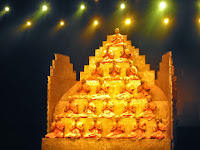
And then its King emerged, his bulky figure dressed in gold that exude an air of royalty under the grandiose spotlights. With an army of fine weaponry and intimidating offensive skills, they were ready to take on their fierce neighboring rivals. While the Khmer army braced themselves for a memorable fight, up in the sky an epic battle between good versus evil, spanned for celestial years with no conclusion, is the "Churning of The Sea of Milk".
Coming to the conclusion of this blog series, I had asked various locals the full story and meaning behind this Hindu folklore, only to be letdown by struggled attempts of explanation. Finally, I found this colorfully illustrated effort. For the non-believers, which includes me, do take it with a pinch of salt.
"Churning of the Ocean of Milk"


The soundtrack of the musical, I wonder if they were the original score. Could easily pass out as Buddhist meditation tracks, adding elements of Asian ethnic musical play. As our attention span slowly started to dwindle, suddenly fountains of rainbow water sprinkled out from the front stage.Call me a caveman, apart from seeing artificial mist floating during play, I've never encountered special effect on stage utilizing water. It was precisely that time fine village ladies wrapped in "Sarongs" danced their way out and shower under the refreshing waterfall.
The show ended by glorifying modern day Angkor as a Buddhist hub and culturally rich country. For all the publicity it made, the Smile of Angkor was a commendable effort in story-telling, visual effects, dance choreography and costume designs. Apart from lamenting the exorbitant ticket price, the show makes for a pleasant evening of eye-opening and heart-warming entertainment. Score: 6.5/ 10.


It was a friendly gesture from the cast whom all emerged at the end of the show for the photography session. Viewers thronged towards the stage for their picture capturing opportunities with the more sought after king of Angkor, beautiful Apsaras and ripped Muay Thai fighters, among all.
Heading out from the grandest multipurpose hall in Siem Reap, our Tuk tuk driver detected us from the mass of crowd and beckoned us towards him. Our next destination was Pub Street, the most happening nightlife spot in town apart from the night market. Outside Pub Street were rows of food shacks, which some may find them dodgy, nevertheless catered various economical local cuisine.


Like its name suggest, pub street was filled with Western oriented bars, cafes, pubs and restaurants. Its no surprise majority of patrons were Westerners, luxuriously splurging their dominant currency in this 3rd world country. I could only wish to visit Europe 1 day due to my country's poorly performing economy. At the corner lot of the buzzing street was Red Piano, which attained its popularity from Angelina Jolie, who frequented the restaurant during the shooting of Tomb Raider.
Being Malaysians, most of us adopt the culture of eating around the clock, since the advent of 24hrs Mamak restaurant. Even after the prior heavy buffet dinner, I could still crave for some Western diet, along with fresh fruit juice. Time was close to 11pm, and most of the eateries were still packed.After all, there weren't much to do after sunset in Siem Reap, besides the usual souvenir shopping and getting a massage.

7th March 2012
6.15am :

Final day of Siem Reap temple trotting as our unexpected foreign adventure was coming to an end. Not before we re-visited the mother of all temple, Angkor Wat, this time against the backdrop of sunrise. At 5.30am the temple enclosure was pitch black, the break of dawn dimly illuminated the domes. Tourist gathered at the lake slightly northwest to the iconic structure, admiring its outline gradually taking demarcation as the sun ray shone through the horizon.

6.20am :

6.30am :
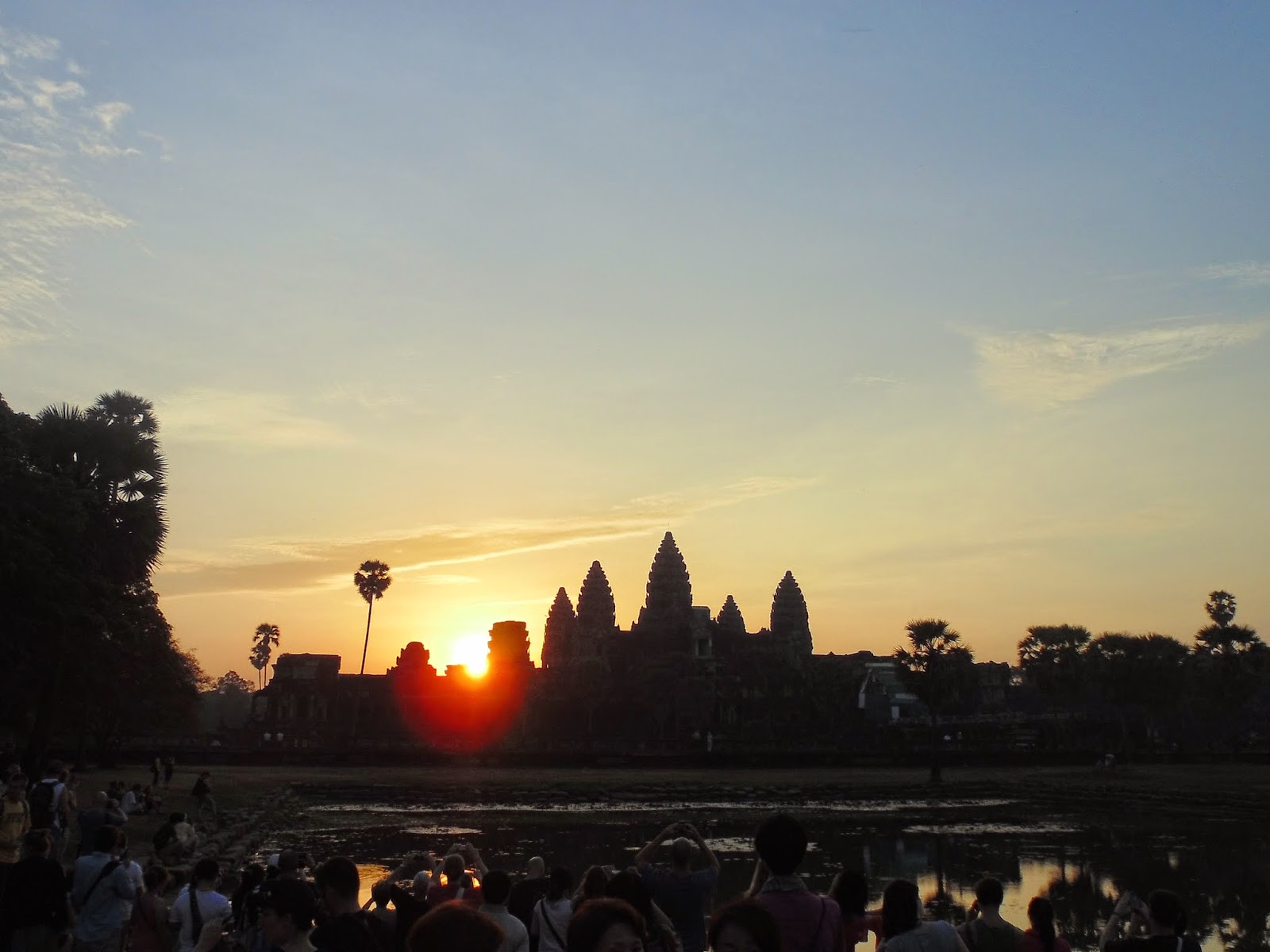
The giant egg yolk which initially emerged with sheepish orange illumination had broken out with fiery bright energy that blend in with the clear blue sky. The grand Angkor Wat with its Cambodian sun smiled at us, as if it was bidding me farewell, given that in 2 hours time we'll be departing home. By now, I could sense Karling's annoyance and restlessness with my obsession of moments capturing.
As i boarded Airasia to return home, I pondered on the amazing once in a lifetime experience I just went through. This excursion was in fact organized impromptu just 1 week ago to make up with Karling after our fights. I doubt she would completely forgive me for my faults but I wont regret this trip now that I have crossed ancient Angkor civilization off my bucket list.
6.45am :


Nothing last forever, as temples can turn to ruins and become desecrated, civilization and culture can be wiped out and forsaken. Therefore I will endeavor to construct a family legacy that last by providing the best upbringing, education and learning experience my children can receive.

The aromatic, flavorful spiced filled Cambodian dish.
First night there, weary from the flight and mentally exhausted from taking in Angkor Wat's magnificence, I remembered returning from the temples and taking a dip in the hotel's swimming pool while Karling collapsed in bed. We didn't do much that night except our hunger brought us somewhere nearby for yummy Cambodian dishes with rice.
So this blog review started from our 2nd night at Siem Reap. Here is my city's night life review..

Massive painting collections everywhere at the Night Bazaar.
The staple food in Cambodia, like all over Asia, is rice, a rich source of carbohydrate. Most of the local restaurant in Siem Reap served rice with local cuisine which consist of meat in aromatic spices, in addition to stir fried vegetables and varieties of clear soup. We walked from our hotel towards the night market district, surveying the rows of eateries along the way.
For a local authentic experience, we patronized the eateries which had local Cambodian eating in it. As we sat down, immediately we were shown a different menu which flashes price of food in USD. So much for the experience, I supposed we had to pay tourist price to dine with the locals. We took it in good stride,however, to support the country's tourism industry. As we were famished, the food tasted so good it almost felt like non-spicy Thai food.

Dance, War, Idolatry Worship were the center of Angkor civilization.

From Cambodian local art and cultural schools emerged many talented painters.
After a hearty dinner, we walked towards the night market at the heart of the business district. Along the way there were several other satellites fleece markets, selling a variety of souvenirs, painting, T-shirts and crafts. The fleece market was neat and organized, where the vendors were polite and not obtrusive. The bright lights illuminated the market and its sale items, which made shopping a breezy and enjoyable experience.

Foot therapy by piranhas wannabes.

Open massage parlor for half body and foot massages.
It is apparent that the bulk of Siem Reap locals derived their rice bowl from art crafts ie paintings, wood crafts, stone carvings, etc. Nearly every corner of the night markets offers sales of paintings, with majority of them depicting Angkor Wat, Bayon temples, landscape of villages, and simple life of the Angkor monks' pilgrimage. Since these paintings are numerous, naturally many are copied version of the original. Credits should still be given to the young talents who candidly repainted or reproduce fail proof original ideas.
Besides oil paintings, there were patterns directly copied from the bas-relief walls of Angkor Wat, showing great celestial war or Angkorian army procession taking place. Being an art admirer, albeit couldn't afford art collection, it crossed my mind multiple times to purchase at least a painting which could decorate my home wall. I finally resisted the urge in order to keep within our limited travel budget.

The bright and colorful night market.

Great place for souvenir shopping.
Along the happening night markets of Siem Reap were the equally busy massage parlors that operated both outdoor and indoor. Masseurs can be seen hard at work giving the majority Western customers a rejuvenating foot, head and shoulder massage. After an exhausting hike around the temple kingdom, these tourist would naturally indulge in a blissful pampering massage that relaxed the mind and promote blood circulation at the same time.
A variant of foot massage came in the form of fish therapy, where one happily dipped his feet into a pool of piranha's domesticated cousins which happily nibble off some epidermis of the feet. We hired a full body massage session each, and were given 2 young chap to ply their trade on us, which wasn't all that remarkable.

Locally made handbags and wide range of accessories.

Wood, stone and metal carvings revolving around Buddhism.

Jeweleries and precious stones.
I haven't been a well traveled person but I believe Siem Reap has a wide array of crafts and souvenirs for sale, all stem from the creatively skillful hands of the locals. Art is a living for them, which can be seen from paintings, wood and stone crafts, fashion accessories, jeweleries, clothing and bags. The market was bright and colorful, only thing missing were the buzzing tourist we encountered throughout the day. Business was a little slow that night, hardly any sight of patrons let alone bargaining.

Pouch and sling bags.

Dry food (front), scarfs and sarongs.
Innovative multi-fabric backpacks and skirts. Buy it if you dare be different.
We came across some shops selling local T-shirts with Angkor Wat theme. After choosing the shop which we reckoned had the most choices in terms of size, color and pattern, we dug for T-shirts as souvenirs and gifts, for both mine and Karling's family. Selling at USD 5-7, these simple attire were made of durable garments that were meant to last. I had a fun and fulfilling time shopping for these economical fail-proof gifts that will soon find their blessed delighted owners.

Traditional health supplement to boost manlihood

Buddha was immortalized through anything Cambodians could find to carve on.
Instead of coming across shops that were exact replicas of each others ie selling the same stuffs, I was feasting my eyes, yes I could only window shop, on the wide array of sales display from each shop. Colorful handbags and backpacks which looked like multiple square shaped fabrics being sewn together caught my eyes. The same outstandingly creative design applied to skirts, which i had some doubt on its fashion savviness.
If these things doesn't stir your interest, how about cobra wine, a locally mixed cocktail derived from cobra, trusted by locals for its male vigor and vitality boosting effects.
6th March 2012

Welcome to Cambodian buffet, also melting pot of various Asian cuisine,except Malaysian.

Smile of Angkor was certainly very expensive.
One of the optional activity that can be missed is the "Smile Of Angkor", a musical performance themed around the creation to peak of Khmer civilization, namely the Angkor and Bayon era. The extravagant and over-priced entrance ticket is inclusive of buffet dinner, consisting a mixture of local Cambodian, Japanese, Korean and Western croissant. Choice of selection and quality was up to standard but don't expect fine dining cuisine.

The face of Bayon became animated and assumed the role of narrator.

Muay Thai class in progress.
We found our way into an air-conditioned medium sized hall, being seated on, what's this, rattan chairs. At least the hall seating were designed in terrace, so that viewers' pleasant evening won't be ruined by smartphones and video cameras obscuring their sights, which was rampant, despite warning (or more of pleas) not to video record and photograph any proceedings.
As the show started, I was eager with anticipation, raising high hopes for "Smile of Angkor" to live up to its wide publicity billing and high ticket price. I sat at the edge of my rattan chair, with my video camera already flashed out...

His majesty the king sits highly on his gold ladden throne.

The elegant temple maids cum dancers.
Combined performance by Chinese acrobats.
Against the impressive cinematic 3D backdrop and synchronized colorful lighting, emerged an angel with wings, gliding above the ground being suspended by wires, interacting with the animated face of Bayon. Bayon's stoned lips moved as it started narrating the story of Angkor's origin.
Khmer was portrayed as a strong military empire with rich cultural development. The multicast agile real life Muay Thai fighters kick-boxed and sparred their way on stage, followed by uniformed sturdy procession of the castle guards. Not to be outplayed were the elegant female casts excelling in their roles of dancers, maiden and mesmerizing Apsaras.

The descent of a beautiful Apsara.
Battle cry lead by chief de mission the king himself.

All this churning for a powerful elixir that would help rule the world.
And then its King emerged, his bulky figure dressed in gold that exude an air of royalty under the grandiose spotlights. With an army of fine weaponry and intimidating offensive skills, they were ready to take on their fierce neighboring rivals. While the Khmer army braced themselves for a memorable fight, up in the sky an epic battle between good versus evil, spanned for celestial years with no conclusion, is the "Churning of The Sea of Milk".
Coming to the conclusion of this blog series, I had asked various locals the full story and meaning behind this Hindu folklore, only to be letdown by struggled attempts of explanation. Finally, I found this colorfully illustrated effort. For the non-believers, which includes me, do take it with a pinch of salt.
"Churning of the Ocean of Milk"

Showering in the waterfall is so refreshing.

Buddhism became the national religion of Cambodia.

Me with the ancient Angkorians.
The soundtrack of the musical, I wonder if they were the original score. Could easily pass out as Buddhist meditation tracks, adding elements of Asian ethnic musical play. As our attention span slowly started to dwindle, suddenly fountains of rainbow water sprinkled out from the front stage.Call me a caveman, apart from seeing artificial mist floating during play, I've never encountered special effect on stage utilizing water. It was precisely that time fine village ladies wrapped in "Sarongs" danced their way out and shower under the refreshing waterfall.
The show ended by glorifying modern day Angkor as a Buddhist hub and culturally rich country. For all the publicity it made, the Smile of Angkor was a commendable effort in story-telling, visual effects, dance choreography and costume designs. Apart from lamenting the exorbitant ticket price, the show makes for a pleasant evening of eye-opening and heart-warming entertainment. Score: 6.5/ 10.

Roses comes in different colors.

The Blue Pumpkin is an ice-cream parlor chain for avid ice-cream lovers, found all over Siem Reap town.

Contemplating the risk of getting cholera
It was a friendly gesture from the cast whom all emerged at the end of the show for the photography session. Viewers thronged towards the stage for their picture capturing opportunities with the more sought after king of Angkor, beautiful Apsaras and ripped Muay Thai fighters, among all.
Heading out from the grandest multipurpose hall in Siem Reap, our Tuk tuk driver detected us from the mass of crowd and beckoned us towards him. Our next destination was Pub Street, the most happening nightlife spot in town apart from the night market. Outside Pub Street were rows of food shacks, which some may find them dodgy, nevertheless catered various economical local cuisine.
Without a doubt the most happening night spot in town.

The Red Piano

While we are still young, we love to eat a lot.
Like its name suggest, pub street was filled with Western oriented bars, cafes, pubs and restaurants. Its no surprise majority of patrons were Westerners, luxuriously splurging their dominant currency in this 3rd world country. I could only wish to visit Europe 1 day due to my country's poorly performing economy. At the corner lot of the buzzing street was Red Piano, which attained its popularity from Angelina Jolie, who frequented the restaurant during the shooting of Tomb Raider.
Being Malaysians, most of us adopt the culture of eating around the clock, since the advent of 24hrs Mamak restaurant. Even after the prior heavy buffet dinner, I could still crave for some Western diet, along with fresh fruit juice. Time was close to 11pm, and most of the eateries were still packed.After all, there weren't much to do after sunset in Siem Reap, besides the usual souvenir shopping and getting a massage.
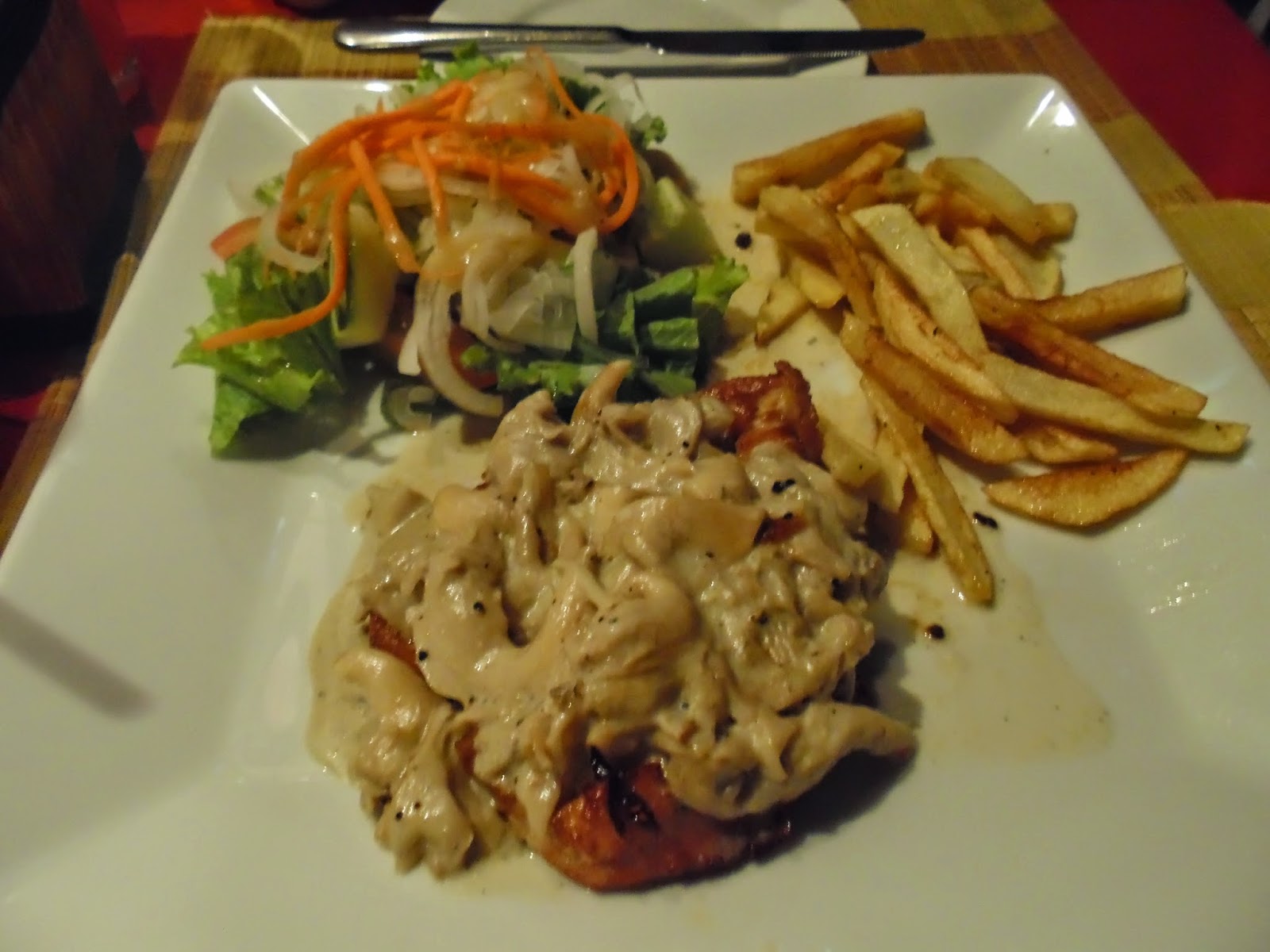
Mushroom sauce grilled chicken with salad and fries.
7th March 2012
6.15am :

Waking up at dawn just for this.
Final day of Siem Reap temple trotting as our unexpected foreign adventure was coming to an end. Not before we re-visited the mother of all temple, Angkor Wat, this time against the backdrop of sunrise. At 5.30am the temple enclosure was pitch black, the break of dawn dimly illuminated the domes. Tourist gathered at the lake slightly northwest to the iconic structure, admiring its outline gradually taking demarcation as the sun ray shone through the horizon.

Oh wait, we're not the only one.
6.20am :

No chairs to sit on.Tired...
6.30am :
The sun is out and shining. Amazing isn't it?
The giant egg yolk which initially emerged with sheepish orange illumination had broken out with fiery bright energy that blend in with the clear blue sky. The grand Angkor Wat with its Cambodian sun smiled at us, as if it was bidding me farewell, given that in 2 hours time we'll be departing home. By now, I could sense Karling's annoyance and restlessness with my obsession of moments capturing.
As i boarded Airasia to return home, I pondered on the amazing once in a lifetime experience I just went through. This excursion was in fact organized impromptu just 1 week ago to make up with Karling after our fights. I doubt she would completely forgive me for my faults but I wont regret this trip now that I have crossed ancient Angkor civilization off my bucket list.
6.45am :

Good bye Angkor Wat. Until next time. Do always stay gorgeous.

One day my grandchildren will laugh at this picture of me.
Nothing last forever, as temples can turn to ruins and become desecrated, civilization and culture can be wiped out and forsaken. Therefore I will endeavor to construct a family legacy that last by providing the best upbringing, education and learning experience my children can receive.


